The No-Surprise IT Playbook (Operator Insights)
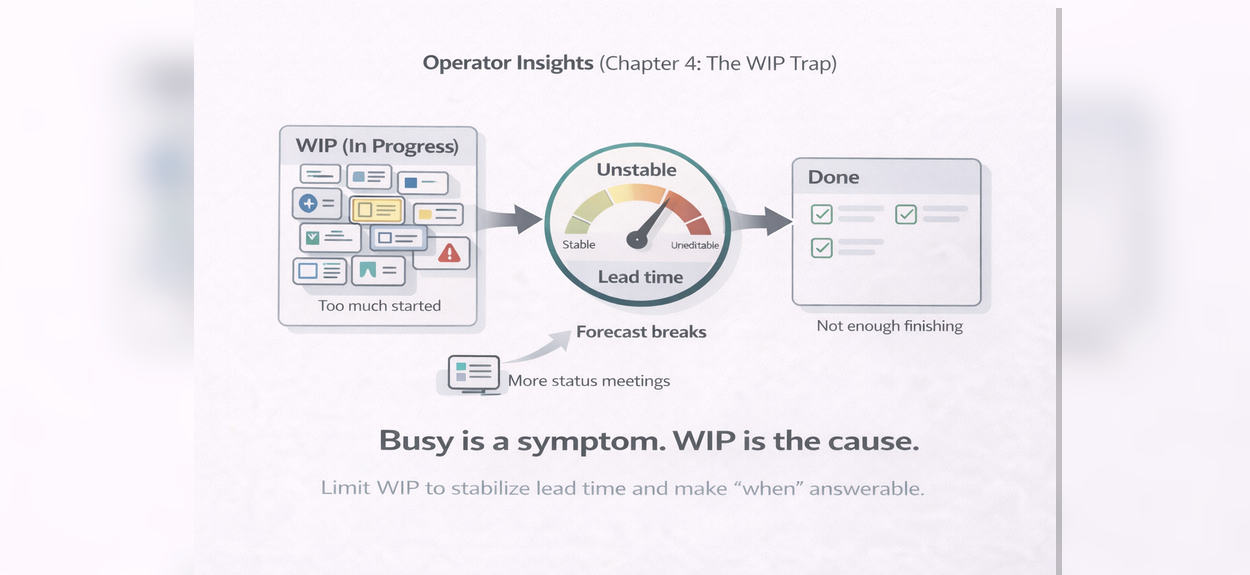
If you’re joining on chapter five: Chapter one covers why side doors create surprises and why the first fix is routing exceptions into a single hub. Chapter two covers the One Queue Rule, because once work is routed you still fail if the org runs on two backlogs. Chapter three covers the Urgent Trade, because urgent will break the ordering unless you force explicit displacement. Chapter four covers the WIP Trap, because nothing is forecastable when everything is started and nothing is finishing.
This chapter is the next constraint in the same system. Even with a hub, one queue, explicit trades, and WIP control, most orgs still fail because intake is optional. Work starts because someone asked, not because it can be classified, owned, bounded, and placed in the ordering. When intake is optional, the work system becomes a negotiation instead of a machine.
Growth companies usually think they have an intake problem when what they really have is an enforcement problem. The form exists. The ticketing system exists. The “process” exists. The reality is that work begins anyway, and the intake artifact gets created later to justify what already happened. That pattern seems harmless until you look at what it does to delivery predictability and cost.
When intake is optional, requirements get reverse-engineered mid-flight. Ownership stays fuzzy. “Done” becomes negotiable. The system becomes harder to forecast, so leaders demand more status, and the cycle repeats. The org burns time twice: first doing the work, then explaining the work, then doing rework because the first pass wasn’t bounded or understood.
What optional intake looks like in the wild
Optional intake rarely announces itself as “we don’t do intake.” It shows up as habits that sound reasonable in isolation:
- Work starts in a hallway conversation, then gets formalized later.
- A request gets routed directly to an engineer because “they already know it.”
- A vendor gets added “for a week” and nobody owns the lifecycle.
- A leader says “just get it moving,” and the team interprets that as permission to skip definition.
- A ticket gets created after the fact with vague language to match the outcome.
In that world, the queue becomes fiction. You can still pretend you have “one queue,” but reality is running on side channels. You can still pretend you have WIP limits, but people can always start work outside the boundary. You can still pretend urgent trades are explicit, but the work started without ever recording what moved.
Optional intake is not a minor hygiene issue. It is the mechanism that reintroduces side doors and shadow backlogs under a different name.
Why adding “process” backfires
This is why process rollouts often make things worse. Leaders notice the chaos and reach for structure: forms, templates, mandatory fields, more stages, more approvals. In a high-pressure environment, that usually produces compliance theater. Forms get filled out after the fact. Tickets get created to justify work that already happened. Dashboards look clean because messy work was never captured properly, or because the fields were filled with whatever kept the request moving.
The org ends up with the worst of both worlds: the friction of process, without the value of control.
The goal is not to make intake heavier. The goal is to make intake real.
The Intake Gate
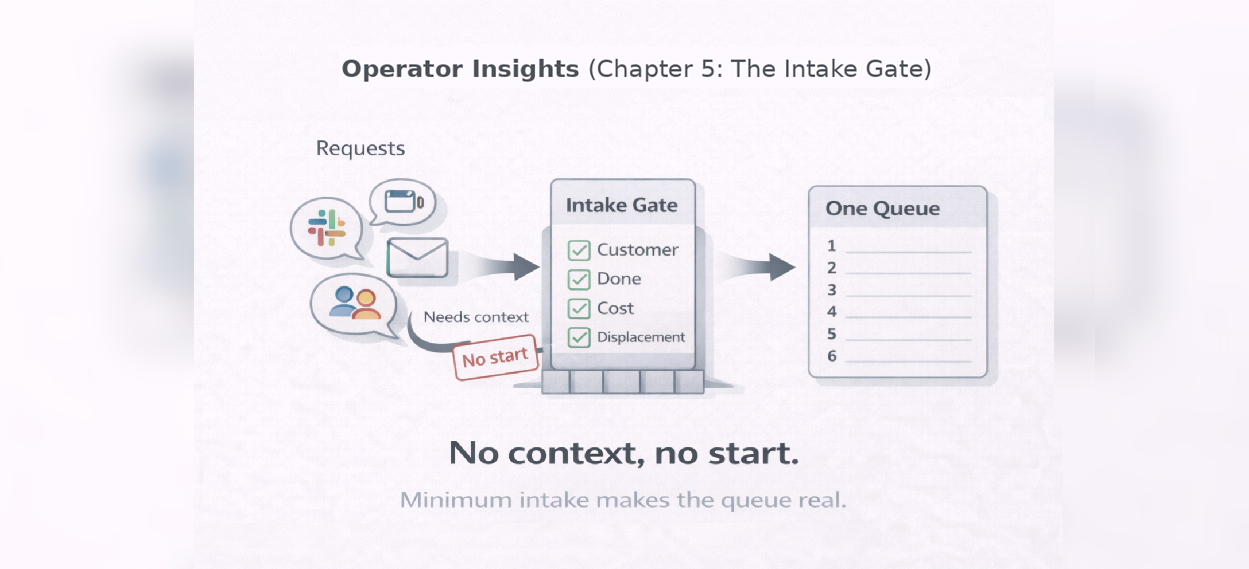
The fix is a gate. Not perfect information. Minimum information. Enough to own the work and place it in the ordering without turning it into a science project.
A real intake gate has one job: prevent unclassifiable work from entering the system. Because once unclassifiable work starts, everything downstream turns into improvisation, and improvisation is the birthplace of rework, surprise cost, and “almost done” purgatory.
There is a simple rule behind the gate: if a request can’t answer basic questions, it doesn’t start.
Minimum viable intake questions
You can keep this brutally short. The point is not paperwork. The point is classification and ownership.
- Who is the customer? Not “who asked.” Who benefits and who can accept “done.”
- What does “done” mean? A concrete outcome. Something you can verify.
- What is the cost profile? Rough order of magnitude is fine. Internal effort, vendor impact, tooling spend, and whether this creates an ongoing run-rate obligation.
- What gets displaced if we do it now? If the answer is “nothing,” you are lying about capacity.
That last question is the forcing function. It links the gate to the prior chapters. One queue requires ordering. Urgent requires trades. WIP limits require stop-start discipline. Intake is the point where you decide whether a request is real enough to compete in that system.
“No context, no start” is not bureaucracy. It’s cost control.
Most leaders fear that a gate will slow the business down. What slows the business down is starting work without enough definition to finish it cleanly. Optional intake creates three predictable costs:
- Cycle time inflation. Work stalls in clarification loops and rework because the definition didn’t exist up front.
- Decision latency. Teams wait for direction mid-flight because ownership and acceptance weren’t clear.
- Hidden spend. Vendors, tools, and “temporary” fixes become run-rate because nobody owned lifecycle and expiry.
A gate does not eliminate urgency. It makes urgency pay for itself with clarity. If something is truly urgent, it should be easy to answer the minimum questions quickly. If it’s hard to answer the questions, that is a signal the request isn’t ready to start, regardless of who is asking.
How to make the gate real (without turning it into a form religion)
The gate works when it’s enforced as an operating rule, not as a documentation preference. A few practical rules make it stick:
- Route everything through the same entry point. If leaders can bypass the gate, the gate becomes optional by definition.
- Make “insufficient context” a normal outcome. Not rejection. A return to sender with specific questions. The system is teaching requestors how to be good customers.
- Don’t let “we’ll fill it out later” exist. Later is how shadow work happens.
- Keep the minimum fields small and non-negotiable. If the fields are too heavy, people will route around them. If the fields are too light, they don’t protect the system.
- Attach the gate to ordering. Passing the gate does not mean “start now.” It means “eligible to be ordered.”
One concrete pattern that works: when someone pushes for an exception, don’t argue about urgency first. Ask for the minimum context and the displacement. If they can’t provide it, the request isn’t urgent. It’s just loud.
The win condition
When it works, intake doesn’t slow the business down. It prevents unclassifiable work from consuming the system and forcing rework later. The queue becomes real. WIP stays bounded. Urgent trades become explicit. “Done” becomes verifiable. Leaders get fewer surprises and fewer “almost done” updates because the work starts with enough definition to finish.
Simple principle: if it can’t be classified, it can’t be started.