Skip to content

IT Operations X-rays for growth-stage and mid-market companies

When product and market fit are there but execution is not, IT Operations becomes an execution constraint.

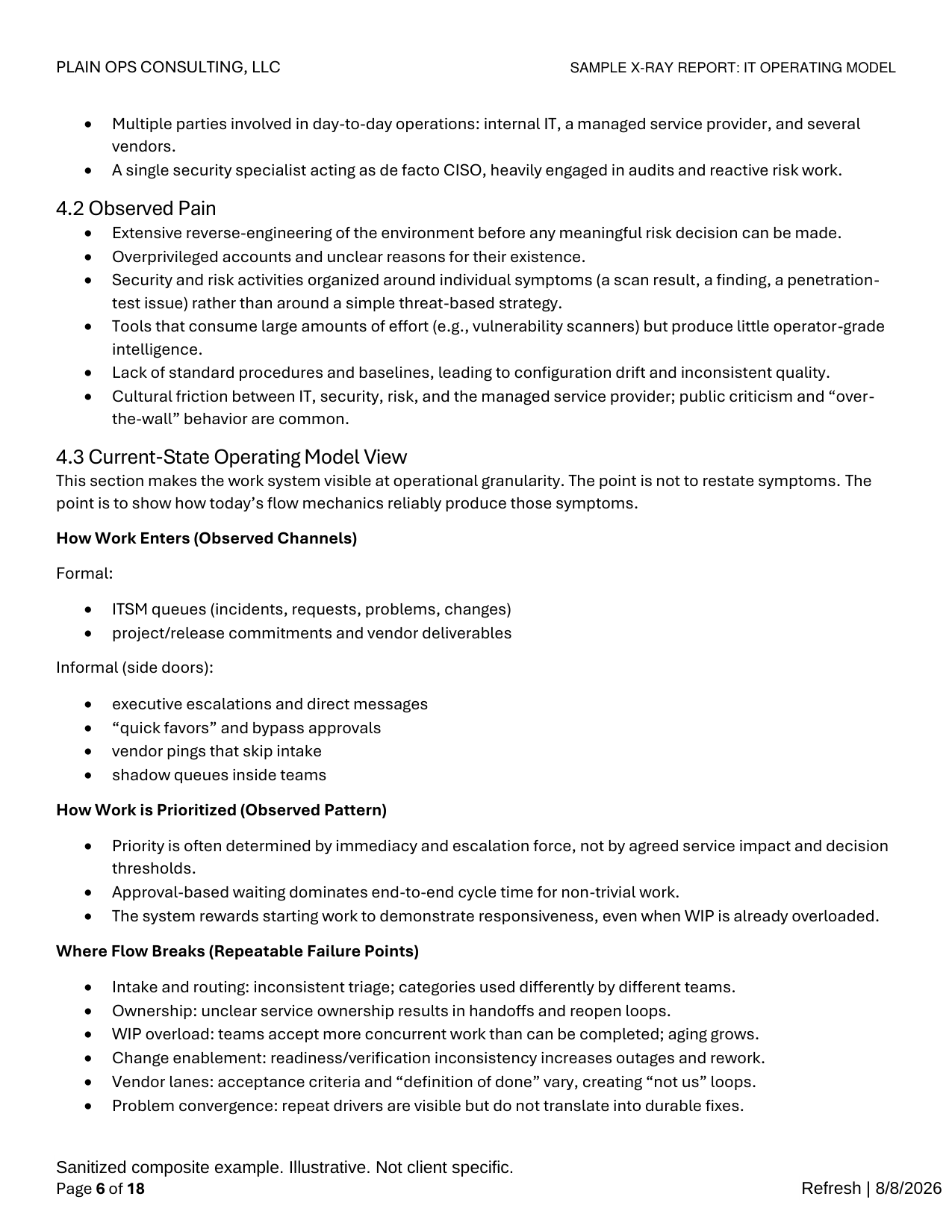
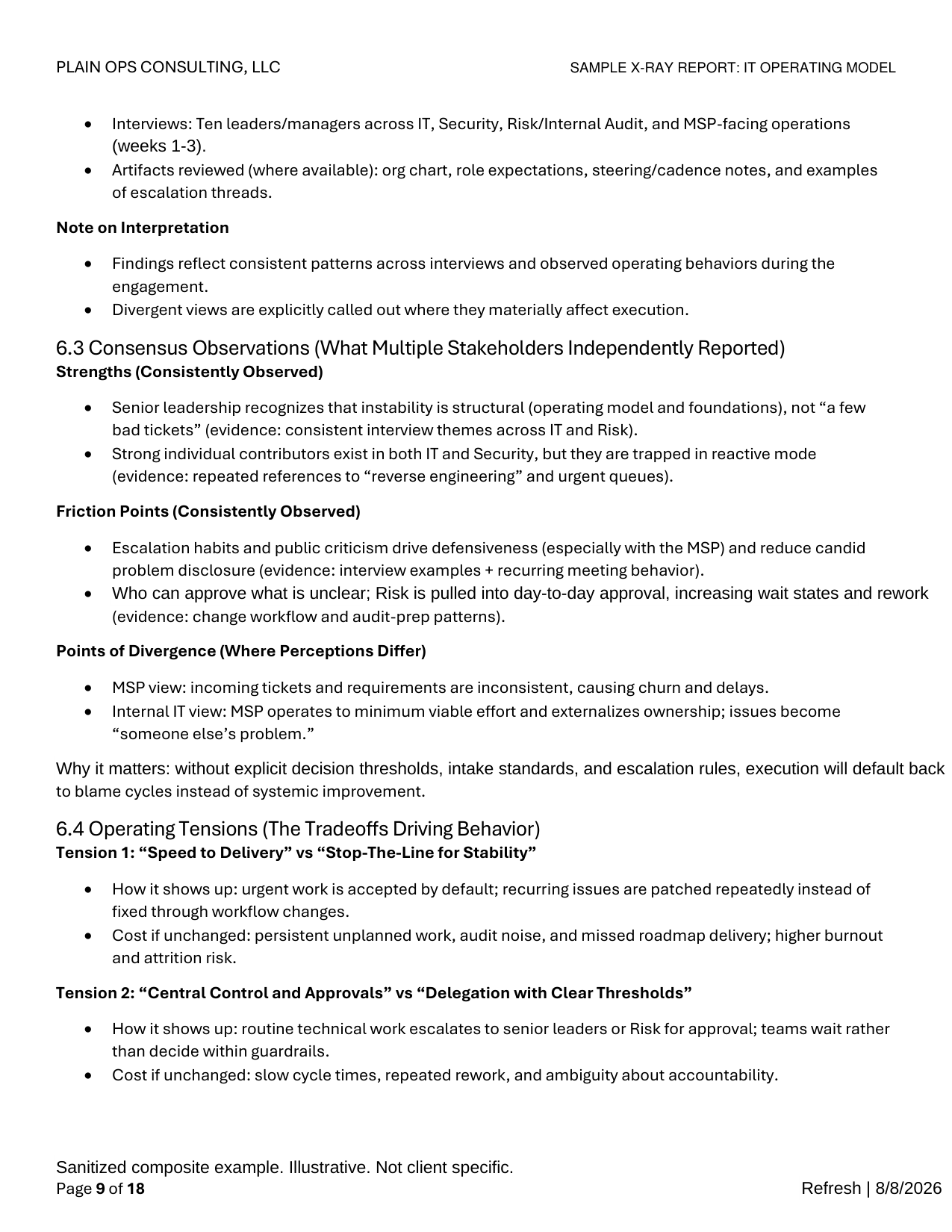
I run time-boxed IT Operations X-rays: map how work really flows across teams and vendors, isolate the 2–3 constraints driving instability and delivery drag, and deliver a prescriptive 6–12 month plan your existing team can run.

The X-ray is a system diagnostic, not performance grading: evidence-tied findings, safe interviews, and no “audit theater” or maturity scoring. No reorg or tool churn unless leadership explicitly chooses it.

Most engagements end with the internal team owning execution; extended involvement only happens if it clearly accelerates predictable delivery or value protection.

Cut the noise. Fix the work.

Plain Ops Consulting: When IT feels like a tax on growth

Incidents eat the roadmap

Incidents and unplanned work consume capacity, so roadmap delivery slows and “critical” work lingers.

Backlogs that never clear

Implementation and onboarding queues grow faster than they’re delivered, so “critical” work lingers for months and becomes invisible noise.

Reliability drift, fading trust

The same classes of outages and degradations keep reappearing, slowly eroding customer confidence and stretching support teams thin.

More dashboards, same problems

New tools, frameworks, and consultants add slideware and dashboards, but day-to-day work patterns and outcomes stay largely unchanged.

Swapping people, not systems

Leaders and vendors are cycled in and out while the underlying operating model is untouched, so the same constraints persist.

“We’re working on it”

Boards hear confident updates from IT, but without operator-grade evidence. The story sounds like risk and drag on valuation instead of leverage for the business.


Operating environments (where this work travels well)

Regulated or audited environments (compliance pressure, change control scrutiny, decision-grade evidence needs)

Vendor-heavy delivery models (handoffs, unclear ownership, MSP lanes, queue opacity)

Execution drag patterns (persistent unplanned work, stalled backlogs, repeat incidents, leadership churn)

For investors and operating partners

  • Independent view of IT stability, scalability, and execution risk.
  • Clear link between operational constraints and growth, margin, or exit timing.
  • A prioritized, trackable list of improvements with indicative effort and impact.
  • Early signal when you have a structure problem, not a “wrong person” problem.

For portfolio company leadership

  • A shared, evidence-based view of where time, risk, and instability actually come from.
  • A bounded plan to move from firefighting toward managed operations.
  • A simple operating rhythm and metric set instead of another deck of slides.
  • Artifacts that make it easier to explain tradeoffs and progress to the board.

Field Examples

Predictable IT Operations

Situation: Incidents recur, queues grow, and urgent work keeps displacing the plan.
Constraint: Decision rights and intake rules are not enforced, so work starts but does not finish.
What changed: Service ownership, WIP limits, and change gates converted noise into stable throughput.
Micro-proof: Queue aging and repeat incident drivers became measurable and reducible.

Delivery Throughput Turnaround

Situation: Go-lives slip because implementation teams are pulled into support and stabilization drags.
Constraint: Delivery and operations share the same experts without an intake boundary, so flow collapses into interrupts.
What changed: Intake separation, go-live readiness gates, and stabilization exit criteria increased throughput.
Micro-proof: Stabilization shortened, emergency changes dropped, and concurrent work increased.

Decision-Quality Roadmap

Situation: Budget cycles reset into buy lists and DR debates because commitments and costs are not decision-quality.
Constraint: No trusted inventory baseline or cost model ties choices to run cost, capacity, and risk.
What changed: Inventory baseline plus requirements plus cost model created predictable CapEx and OpEx decisions.
Micro-proof: Roadmap became the budget backbone with auditable DR evidence and quarterly reforecasting.